
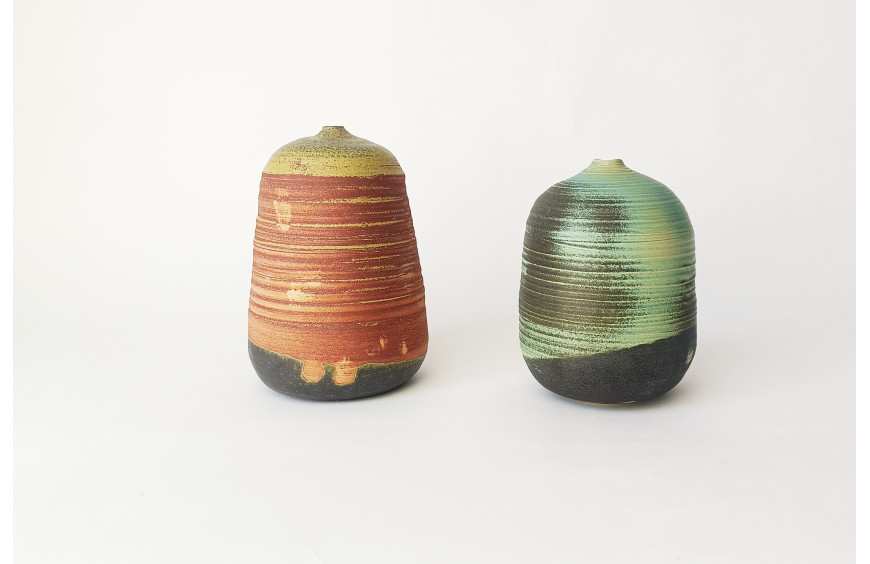
New Mid-Century Inspired Sculptural Vessels
Silence, form and the language of clay
These new sculptural vessels explore a dialogue between mid-century modern aesthetics and contemporary studio ceramics.
Their quiet, closed forms evoke the contemplative objects created by artists such as Toshiko Takaezu, whose work blurred the boundary between vessel and sculpture. Like those historical references, these pieces are not conceived primarily as functional objects, but as forms for contemplation.
The silhouettes are simple and balanced — almost architectural — allowing the surface and the subtle rhythm of the form to speak.
Colour, surface and Mediterranean earth
The glazes move between mineral greens, oxidised bronze tones, warm terracotta reds and volcanic dark bases.
These colours were chosen to evoke natural landscapes:
- weathered stone
- Mediterranean earth
- oxidised metals
- moss and mineral surfaces
The glaze layers create gentle transitions and atmospheric surfaces that shift with light. No two firings behave exactly the same, so the resulting skin of each piece remains unrepeatable.
Hand-thrown forms and artistic collaboration
The vessels were wheel-thrown in collaboration with the ceramicist Núria Carrascal, an exchange that allowed the forms to emerge with precision and fluidity.
Afterwards, the surfaces were finished and glazed by hand in my studio, where the pieces were fired at high temperature to develop their final textures and colours.
This dialogue between two hands — throwing and glazing — adds another dimension to the objects, reinforcing their character as studio pieces rather than production ceramics.
The beauty of the trace: marks of the hand
Across the surface, subtle finger marks and rhythmic gestures remain intentionally visible.
This approach resonates with a philosophy present in many Japanese ceramic traditions:
the idea that the trace of the maker is part of the work itself.
Rather than hiding these marks, they are preserved as a testimony of the process — small evidence that each object was shaped slowly and directly by hand.
They become a quiet reminder that the piece is not a moulded product, but a singular encounter between clay, fire and gesture.
One form, one piece
Each vessel is completely unique.
For every form I create only one version of the shape and glaze combination. Once a piece is finished, that exact configuration will not be repeated.
Over time, new vessels will be added gradually to the collection on my website — each one emerging from a slightly different exploration of form, colour and surface.
They are conceived as small sculptural presences for calm spaces.
Deja un comentario Cancel Reply